

Europe has an almost unfair advantage when it comes to travel. Within a single continent you can wander through medieval alleyways in the morning, eat a three-course lunch by the ocean at noon, and watch the sun set over a skyline that has been standing for centuries by evening. But with dozens of world-class cities competing for your attention and limited time in any given year, choosing where to go matters. This guide cuts through the noise and highlights the European cities that are genuinely worth your time in 2026, from perennial favorites earning their reputation anew to under-the-radar gems finally having their moment.
1. Lisbon, Portugal
The city that glows golden at every hour
There is a reason Lisbon has consistently topped European city rankings for the better part of a decade, and that reason has not faded. Built across seven hills above the Tagus estuary, Lisbon offers a rare combination of spectacular light, genuine warmth, and a lived-in energy that never feels performed for tourists. The Alfama district, with its maze of terracotta-roofed houses and the haunting sound of fado drifting from open windows, remains one of the most atmospheric neighborhoods in all of Europe. The food scene has quietly matured into something remarkable: traditional pastéis de nata and grilled fish still anchor the experience, but a new wave of chefs has added real contemporary depth. Getting around on the historic yellow trams, pausing for a glass of vinho verde at a miradouro (viewpoint) at sunset, and wandering into a tile-covered church on a whim are the kinds of experiences that make Lisbon feel inexhaustible. It is one of those cities that rewards slow travel above all else.
2. Bologna, Italy
Italy’s best-kept culinary secret
If Rome and Florence get the headlines, Bologna quietly gets the credit among people who actually know Italy well. The capital of the Emilia-Romagna region is the country’s undisputed food capital, the birthplace of ragù, tortellini, and mortadella, and the home of a food market culture that puts most other European cities to shame. But Bologna is far more than a dining destination. Its medieval porticoes (over 38 kilometers of covered arcades weaving through the city) are a UNESCO World Heritage Site, and the university that has operated here since 1088 gives the city a youthful, intellectual energy. The pace is slower and more local than the big tourist cities, prices are noticeably lower, and the architecture is a warm terracotta red that turns breathtaking in the late afternoon light. For travelers who feel like they have already done Rome and Florence, Bologna is the answer to what comes next.
3. Seville, Spain
Where passion, heat, and history collide
Seville is the kind of city that grabs you immediately and does not let go. The capital of Andalusia is everything you imagine when you picture Spain at its most vivid: flamenco performed in candlelit caves, orange trees lining every street, an enormous Gothic cathedral that took over a century to build, and a tapas culture so deeply embedded in daily life that eating at the bar counter before noon barely raises an eyebrow. Visit in spring (April and May) to catch Seville at its most festive, with the Feria de Abril filling the city with color, music, and celebration, or in October and November when the summer heat has broken and the city slows to a more relaxed rhythm. The Triana neighborhood across the river from the historic center has a distinct character all of its own, and the Alcázar palace complex is arguably the most beautiful building in Spain. Seville is not a city you visit once.
4. Ljubljana, Slovenia
Europe’s most walkable capital, almost entirely undiscovered
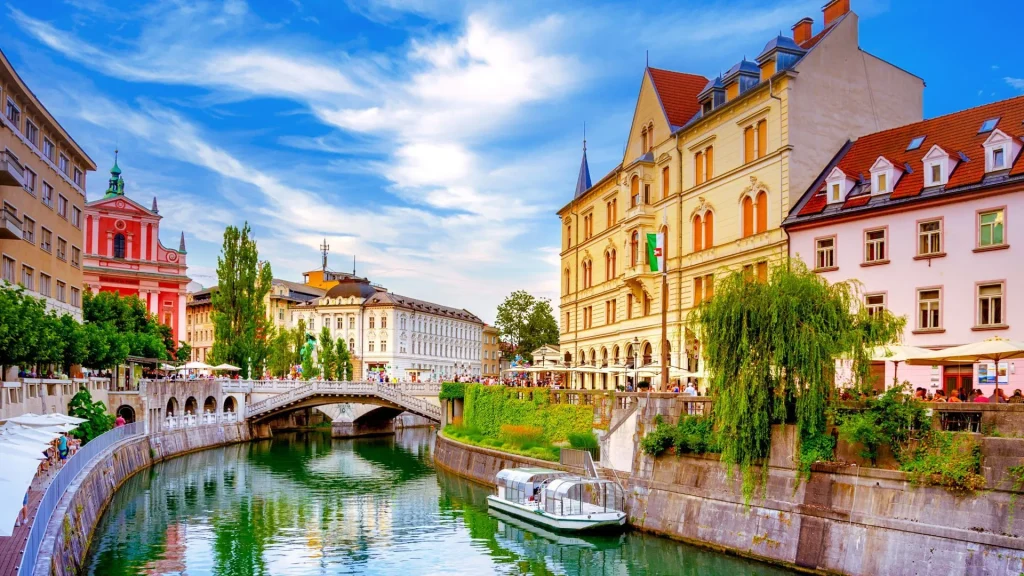
Slovenia’s capital remains one of the genuine surprises of European travel. Small enough to explore thoroughly on foot in a weekend, yet layered enough to reward a longer stay, Ljubljana is a pedestrian-friendly, architecturally rich city with a thoughtful food scene and a cycling culture that feels genuinely embedded in daily life. The city center, much of it designed in the early twentieth century by the architect Jože Plečnik, has a coherence and beauty that larger, more visited cities can only aspire to. The castle on the hill above the old town offers views over a skyline that has barely changed in decades. The nearby Lake Bled is justifiably famous and easily reachable as a day trip. Ljubljana is the kind of place experienced travelers recommend to each other without wanting it to become too well known.
05 Ghent, Belgium
Medieval Bruges without the tourist buses
Ghent is what happens when a medieval Flemish city refuses to become a museum piece. Unlike its more photographed neighbor Bruges, which can feel overwhelmed by day-trippers in peak season, Ghent is a working, student-populated city that simply happens to have an extraordinarily beautiful historic center. Three towering medieval churches rise above the canal waterfront, the streets are lined with guild halls and gabled townhouses, and the entire thing lights up magnificently after dark when most of the day-trippers have gone home. The food scene punches well above its size, the beer culture is world-class (this is Belgium, after all), and the city runs a genuinely impressive contemporary art scene. Ghent is the kind of destination that makes you wonder why more people are not already talking about it.
6. Porto, Portugal
Gritty, gorgeous, and entirely addictive
Porto occupies a special place in the affections of everyone who has spent time there. It is rougher around the edges than Lisbon, steeper, louder, and more industrial in places, and somehow all of this makes it more compelling. The ribeira waterfront, with its colorful warehouses and the Dom Luís I bridge arching overhead, is the kind of view you find yourself returning to again and again throughout a visit. The port wine cellars across the river in Vila Nova de Gaia are an essential experience: tasting tawny and ruby ports in their actual home cellar, often from a producer who has been making wine in the same building for over a century, is one of those travel experiences that simply cannot be replicated anywhere else. Porto rewards wandering: streets that look closed turn out to contain extraordinary tile-covered churches, and the bookshop Livraria Lello, which inspired parts of the Harry Potter universe, remains one of the world’s most beautiful interiors.
7. Tallinn, Estonia
The most intact medieval old town in Northern Europe
Tallinn is a revelation for first-time visitors, and a city that experienced travelers frequently cite as one of the most underrated in Europe. Its UNESCO-listed old town is genuinely, startlingly well-preserved: cobbled streets, intact city walls, Gothic town halls, and church spires that look exactly as they would have five centuries ago. Yet Tallinn is not frozen in the past. The city has built a thriving tech sector (it is the birthplace of Skype and a global pioneer in digital governance), and the restaurant scene in the hip Telliskivi creative district rivals anything you would find in Berlin or Copenhagen. The summer months bring long Baltic evenings with daylight stretching past eleven at night, while December turns the old town into what may genuinely be the most atmospheric Christmas market in Europe. Tallinn works beautifully in any season.
08 Marseille, France
France’s most misunderstood city is finally having its moment
Marseille has long suffered from an undeserved reputation that kept cautious travelers away, and the city that actually exists bears little resemblance to the caricature. France’s oldest city and its second largest is a raw, multicultural, sun-blasted Mediterranean port with a bouillabaisse tradition that is practically a civic religion, a stunning rocky coastline south of the city known as the Calanques, and a street art scene that rivals any in Europe. The opening of the MuCEM (Museum of European and Mediterranean Civilizations) transformed the old port area into a genuinely exciting cultural quarter, and the climbing and kayaking access offered by the Calanques National Park on the city’s doorstep is extraordinary. Marseille requires a slightly more adventurous approach than some other cities on this list, but that is precisely its appeal. It gives back generously to travelers willing to meet it on its own terms.
9. Krakow, Poland
Central Europe’s most beautiful city, priced for every traveler
Krakow belongs in any honest list of Europe’s finest cities. Its main market square, Rynek Główny, is the largest medieval town square on the continent and one of the most beautiful public spaces in Europe regardless of category. The Royal Castle on Wawel Hill above the Vistula river is a major piece of European history, and the Jewish quarter of Kazimierz has evolved into one of the most fascinating neighborhoods on the continent, a place where history, culture, and a thriving contemporary restaurant and bar scene coexist in productive tension. Krakow is also, relative to Western European capitals, remarkably affordable: quality accommodation, excellent food, and a rich cultural calendar at prices that make the city genuinely accessible to a wide range of travelers. The proximity of Auschwitz-Birkenau, while not a conventional tourist attraction, makes Krakow an important destination as well as a beautiful one.
10. Athens, Greece
Ancient history, modern energy, and arguably Europe’s best food right now
Athens is in the middle of a remarkable reinvention. The city that spent much of the last decade defined by economic hardship has emerged as one of Europe’s most energetic and exciting urban destinations. The Acropolis remains what it has always been, one of the most breathtaking structures built by human civilization, and standing beneath the Parthenon as the sun drops behind Piraeus is an experience that resists comparison. But the modern Athens story is about the neighborhoods: Monastiraki’s chaotic, exhilarating street market, Exarcheia’s anarchic creative energy, Koukaki’s restaurant-dense streets, and the sweeping Athenian Riviera stretching south of the city along the Saronic coast. Greek cuisine has undergone a genuine renaissance in Athens, with a new generation of chefs applying serious technique to the country’s extraordinary produce. Come for the ancient city, stay for the living one.
How to choose your next European city
The ten cities above share one quality above all others: they reward the traveler who arrives with curiosity and time rather than a checklist. Europe’s greatest cities are not experienced by ticking off landmarks. They are experienced by lingering over a second coffee, by accepting an invitation from a stranger, and by allowing an afternoon to become an evening without a plan.
If you are choosing between these destinations, start with the question of what you need most from the trip. Rest and warmth point toward Lisbon, Seville, or Athens. History and architecture at a slower pace suggest Bologna, Tallinn, or Krakow. Off-the-beaten-path discovery belongs to Ljubljana, Ghent, and Marseille. Porto and Ghent suit the traveler who wants to feel like they have found something not everyone knows about yet.
Whatever you choose, Europe in 2026 remains one of the world’s great travel experiences. The continent’s cities have survived centuries of transformation and emerged, each time, more interesting than before. All you have to do is show up.